22 July 2013

General Meeting - July 2013 - Movie Night

Movie Night was a hit!  Double feature, popcorn (all you can eat!), lemonade and other refreshments made for a wonderful evening.

The SJAA recently took possession of a brand new, larger, wall mounted projection screen and it was being mounted at the front of the room.  The idea was to replace the freestanding, square, smaller and 1960s vintage screen that had served well for decades.

screen installation
Screen installation in process

The screen installation crew, consisting of long time SJAA'er Mark Wagner, Mr Can-Do Dave Ittner, and go-getter Jose Marte, ran into some early technical troubles. But nearly everyone in Silicon Valley being or having engineer leanings, those troubles were quickly and creatively solved so the job could be completed in time for the screen's first light, the SJAA's first ever Movie Night, which was this month's manifestation of the General Meeting.


Installed!

As usual, there was a board meeting scheduled before the general Meeting, which started late due to the installation's schedule being overly optimistic (it didn't account for pizza breaks or other such obstacles).  But with strong leadership, all the club business was addressed, decisions were made, and nearly all world problems were nearly solved. (Yes, Dave got his additional budget for the QuickSTARt program!)

Seven thirty PM arrived, and the popcorn started to pop, and the lemonade began to tart.  Teruo Utsumi, who generously donated his Denon/Klipsch sound system for the evening, solved his own technical problem of the receiver overheating. A 24" fan was placed face down on the unit, cooling the massive heat sink for the duration of the evening. Again, engineering prowess demonstrated.

During social (half) hour, trailers from the upcoming movies were played until eight PM, the official start time of the meeting.  Prez Rob spoke a few introductory words before quickly sitting down, and the Play button was hit.  Only at a 50s-era drive in was Forbidden Planet seen on a bigger screen.  Upon the first film concluding, bio breaks were taken, more corn was popped, then Play was hit once again to bring up Star Wars IV in all its original 70s fx glory.  Han and Leia never looked so good at Houge Park.
 

The second feature ended around midnight, the room emptied quickly, and cleanup and gate locked by half past.  It was a fun night, we may have to do it again.

And let's roll the credits:

A/V gear and DVD procurement - Teruo Utsumi

Screen Procurement - Michael Packer
Screen Installation - Dave Ittner, Jose Marte, Mark Wagner
Popcorn Rental  and Procurement - Michael Packer

Popcorn Popping - Rob Jaworski
Liquid Refreshments, Procurement and Development (ie, buying, mixing the lemonade powder) - Teruo Utsumi
Getting the Kitty/Tip Jar Started and First Donation - Jay Freeman Cleanup - Michael Packer, Rob Jaworski, Teruo Utsumi
Show of Appreciation for All That SJAA Does (a Hundred Dollar On-The-Spot Donation to SJAA) - anonymous

Everyone Who Showed - Thank You!

16 July 2013

Grand Canyon Star Party


Sunset over Grand Canyon before the Star Party

I expected that the highlight of my June trip to Arizona would be to attend two nights of the 23rd Annual Grand Canyon Star Party at the South Rim.  Just in case of clouds at the party, I packed my 10x50 binoculars, tripod, and camp stool, so I could go northern Arizona star gazing every clear night.  I also knew the moon would have a bigger impact each night.  The Star Party started at New Moon, June 8, 2013, but it lasts 8 days, so the moon would be nearly First Quarter by the time I got to the Star Party.

I was taking a Road Scholar program, an educational tour consisting of astronomy lectures by professors of Northern Arizona University at Flagstaff , field trips to Lowell Observatory and Meteor Crater, and culminating with the Grand Canyon Star Party.  (I made separate blog posts for Lowell Observatory and Meteor Crater.)  There were a few star gazing enthusiasts like me (one couple drove from Tennessee so they could bring their 8” telescope), but there were also folks from Manhattan and Brooklyn who said they never got to see stars, and just wanted to see some stars.

The first night in Flagstaff, elevation around 7000, was cloudy. The next night in Flagstaff was very clear, and I was eager to see the view through the 24” Clark refractor at Lowell Observatory.  But I called and was told that it was so windy that they could not open the Clark dome.

 I did the best I could on my own, even without a car.  Flagstaff is designated an “International Dark Sky City”, but there were still lots of streetlights around the motel.  It is located at the end of a street which dead ends at a little hill with no lights to the north, but lots of street lights on all other sides.  I put up the hood of my sweatshirt, pulled it out as far as I could to block the light from the sides, looked to the north through my binoculars, and, oh my goodness, so many stars!!!  Even with all these street lights around me, I could just glance up and see the Coma Berenices Cluster.  Walking back to the motel, I could see Scorpius shining brightly, so I decided to try to see globular cluster M4.  I thought it would be futile because I was looking straight into the street lights, but I gave it a try.  To my delight, with my binoculars I could see M4 very clearly.  Flagstaff skies at 7000 feet are so different from Silicon Valley skies.

Then it was on to the South Rim of the Grand Canyon.  The Grand Canyon Star Party began as the first anniversary of Dean and Vicki Ketelsen’s honeymoon there, and telescopes set up by the Canyon proved so popular with tourists, that the event became an annual tradition as a public oriented event.  Skies are typically clear in June at the Grand Canyon whereas monsoon season typically begins later in the summer.  Arizona does not observe Daylight Savings Time, so skies get dark earlier in the evening at the Grand Canyon than in Silicon Valley.  The Tucson Amateur Astronomy Association hosts the Star Party on the South Rim and the Saguaro Astronomy Club based in Phoenix hosts the Star Party on the North Rim.


Mercury and Venus over Grand Canyon

I took this photo of Venus and Mercury above the Grand Canyon from Mather Point.  Mercury is barely visible at a 45 degree angle to the left and above Venus.   I photographed this scene over and over as the sky darkened.  People asked me what I was doing, and I got to point out Mercury to many people who had never seen it before.  Using Venus as a guide, everyone was eventually able to spot it.


Sitting with my binoculars at Mather Point watching the canyon darken and the stars come out was absolutely the highlight of my trip.  The moon was out, and I could see my shadow clearly, so I felt no fear that I would accidentally fall into the canyon.  Also there are big strong metal railings at Mather Point.  By all the green laser lights pointed to the sky, I could see that the Star Party had begun, but I did not want to leave the glorious vista of horizon to horizon bright stars above and the moonlit canyon below with only one small light at Phantom Ranch  It was hard to do, but eventually I pulled myself away from the canyon and walked in the moonlight and the light of my flashlight to the Star Party.  By the time I got there, the crowds had thinned, and I got to see fabulous views through the big telescopes.

The night was very short so close to Summer Solstice, and I didn't get up in time to see the sunrise.  The South Rim gets quite hot by midday, so I was up hiking a little ways down the Bright Angel Trail before breakfast and before the sun got very high.

Solar Viewing at Grand Canyon South Rim

Members of the Tucson AAA set up for solar viewing right on the South Rim between the shuttle bus stop and the Bright Angel Trail head.  I got to see solar prominences, but no sun spots.


View of Grand Canyon from Powell Point on Hermit Road

The weather was beautiful, and the daytime sightseeing spectacular, especially strolling along the Rim Trail and enjoying many viewpoints along Hermits Road.  Not having a car was no problem due to the excellent free shuttle buses.  Then it was time for the second night of star gazing at the Grand Canyon Star Party.

View of Canyon at sunset from Yavapai Point

A group of Road Scholars skipped the ranger talk to photograph the sunset from Yavapai Point.

Setting up telescopes for Grand Canyon Star Party
The amateur astronomers set up their telescopes in the employee parking lot at the Grand Canyon Visitor Center at Mather Point. The area is several hundred feet from the rim, so there is no danger of anyone falling into the canyon. As recently as last summer they had set up their telescopes at Yavapai Point, but that had the big disadvantage that the shuttle buses came by every 15 minutes, spoiling everyone’s night vision each time.

I was very impressed with the large reflecting telescope whose mirror you can see to the right of the tall ladder.  The view of the M13 globular cluster from that telescope was fantastic!  To me it looked just like the photo of M13 in my star gazing app.

Star Party has just begun
In this photo the ranger talk was just over, the crowds were arriving, and Star Party had just begun. I took this photo with ISO 1600, exposure time 1 sec, so the scene appears light, but it was actually quite dark, and the astronomers were sharing very good views of Mercury and Saturn.  I estimate there were forty telescopes, mostly set up by amateur astronomers from Tucson, although I spoke to one who made an almost annual trip from Texas.  At first the crowds were heavy, and the lines at the telescopes were quite long, but they thinned out after 10 PM. The evening also included a bright Iridiuim flare, a very nice pass by the International Space Station, and hourly green laser Constellation Shows, all announced ahead of time by the astronomers.

I had a wonderful time, and I especially loved sitting at Mather Point watching Mercury and Venus sink while the canyon got dark and the stars appeared. One thing that I missed was watching the Milky Way rise over the canyon.  I would like to go back in the dark of the moon so I could see that.

08 July 2013

Meteor Crater, Winslow, AZ

Below are photos of Meteor Crater, Winslow, Arizona from my visit in June 2013.   The crater is located about 40 miles southeast of Flagstaff. It was formed when an estimated 45 meter meteorite hit about 50,000 years ago. The first photo shows the crater, nearly one mile across, 2.4 miles in circumference, and about 550 deep.


Panorama of Meteor Crater

Click to enlarge this panorama which was stitched together with Photoshop Elements.  Viewing platforms are in the foreground. Remnants of mining for the meteorite are still visible at the bottom of the crater.  The visitor center is at the far right.  Above that in the photo are the trail used for the guided Rim Tour, and a group of people taking that tour.

At first the crater was thought to be of volcanic origin.  In 1902 Daniel Moreau Barringer, a mining engineer, became convinced the crater was caused by the impact of a large iron meteorite.  He spent the rest of his life mining in the crater in an unsuccessful attempt to find it.  According to the excellent museum at the visitor center and their very informative website, he could not find it because it did not exist--it was broken up into tiny pieces:

  • Very small percentage stripped away by atmospheric friction before impact
  • Very small percentage vaporized upon impact, then recondensed into tiny fragments raining over a 7 mile radius
  • About half blasted out upon impart, landing on the rim and surrounding plain
  • About half is present in very tiny fragments beneath the crater floor to a depth of 3,000 feet

Barringer did live long enough to see the scientific community start to accept his theory that the crater was formed by a meteorite.


Meteorite found in Diablo Canyon
 This piece of the meteorite is on display at the Lowell Observatory visitor center.  The sign says, "Meteorite. 535 lbs. 242.6 kg. Found in Canyon Diablo near Meteor Crater. This is a small particle of the meteor which formed Meteor Crater, about 50,000 years ago. 92% iron, 8% nickel, traces of gold, silver, platinum and diamond."


Strata along the rim
 This photo shows the strata at the rim.  Impact craters have been called “nature’s drills” because they sort of invert the strata.  Apollo astronauts trained at Meteor Crater under the guidance of Dr. Eugene Shoemaker (part of the team that discovered Comet Shoemaker-Levy 9) because Meteor Crater is so much like craters on the moon.  By recognizing impact craters on the moon, the astronauts could collect samples of rocks originally from below the surface without having to drill for them.


Distant view of Meteor Crater
 Here is a distant view of the crater. The land around the crater used to be flat until the meteorite hit, creating the impact crater and depositing debris around the rim.

07 July 2013

Solar GSSP Tidings

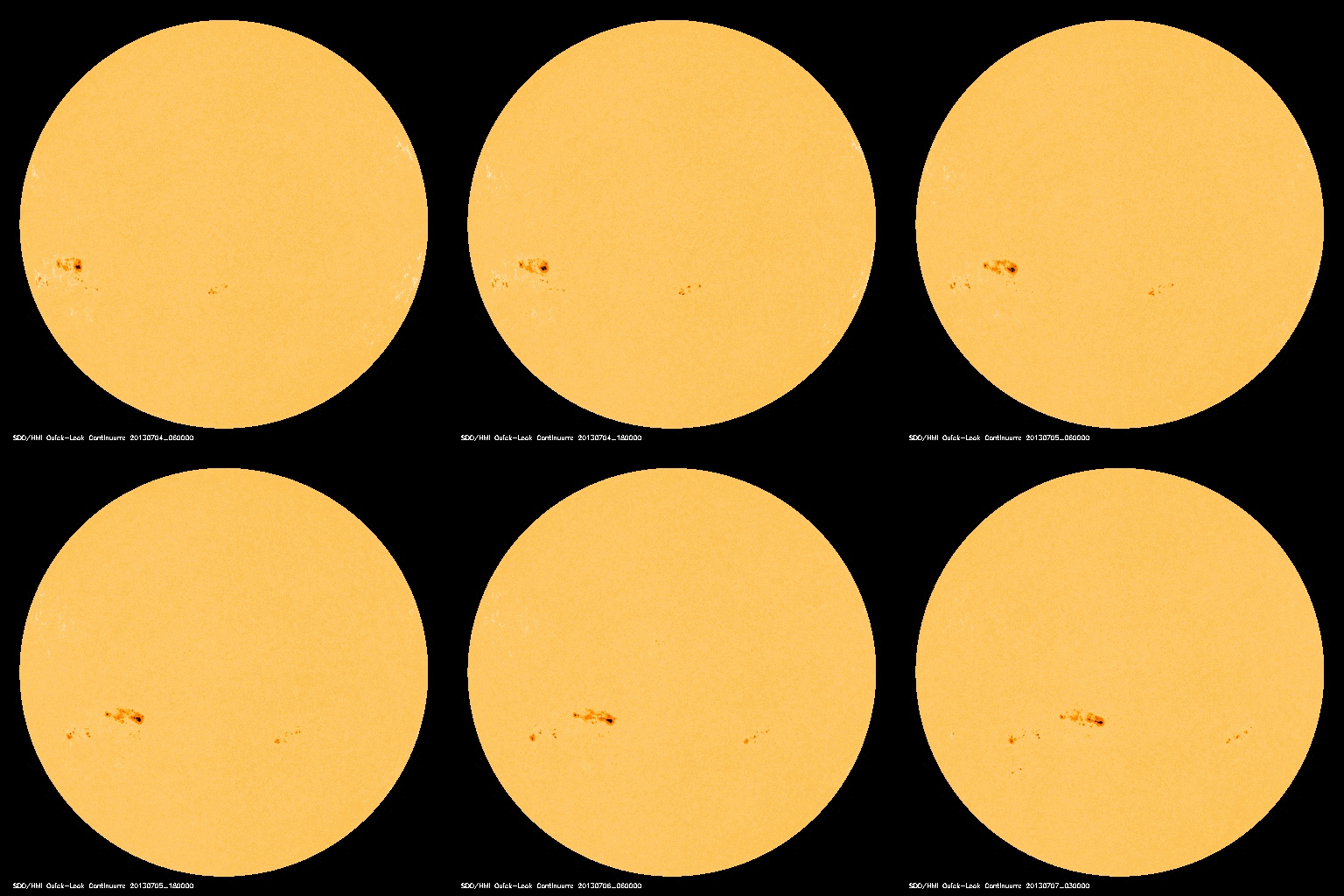
Behemoth sunspot AR1785 is undergoing a metamorphasis, changing shape by the hour as it turns toward Earth. This movie from NASA's Solar Dynamics Observatory shows the action on July 6-7:


And Here's a Pic from Michael Packer 80mm Refractor + Standard Solar filter using a hand held LX5 at the Eyepiece.


And here is an H-alpha shot from Robert Duvall from Houge Park - Home of SJAA:

Click to enlarge!


This pic was taken near Adin CA and in other words:

The Golden Gate Star Party 2013 Has Started!


26 June 2013

Lowell Observatory, Mars Hill, Flagstaff, Arizona

Below are photos of the historic telescopes of Lowell Observatory, Mars Hill, Flagstaff, Arizona, elevation 7,200 feet, from my visit in June 2013.  The first photo is of the Clark Telescope, a 24” refractor, which Percival Lowell had built in 1896 so that he could study the “canals” on Mars.  The lens was designed by Alvan Clark, the last lens he designed before he retired.


Clark Dome
Observe the non-spherical shape of the Clark Dome.  It was built of locally grown ponderosa pine by the Sykes Brothers, bicycle mechanics, who advertised themselves as “Makers and Menders of Anything”. Mars Hill is an easily accessible hill about one mile west of downtown of Flagstaff.


Clark 24" Refractor Telescope

The Clark Telescope is now used only for public outreach.  It is open for daytime tours and, if weather conditions allow, nighttime viewing until 10 PM every summer evening.   The dome rotates on tires, obtained from the Ford Motor Company and installed in 1957, most including hubcaps, replacing the original worn out metal wheels.


Inside of Clark Dome
The dome is composed of flat planes of wood instead of today’s spherical surfaces.  The roof doors are flat panels that open outward, and turn into sails in high winds, so cannot be opened if the wind exceeds 15 mph.  I did not get to view through the telescope due to the wind.  The lens cover of the large finderscope on the left is a skillet stolen from a good cook's kitchen.


Dome of Pluto Discovery Telescope


Lowell started searching for “Planet X” in 1905 because he thought an unknown planet changed the orbit of Neptune and Uranus, and he continued this search until his death in 1916.  Once his estate was finally settled, Lowell's younger brother, A. Lawrence Lowell, president of Harvard University, provided funds to construct the dome and telescope used to continue the search.  It was completed in 1929.


Pluto Discovery Telescope
Clyde Tombaugh, a Kansas farm boy who got a job at the Lowell Observatory based on the sketches of planets that he had sent, used this astrograph to find Pluto.  The “Pluto Discovery Telescope” has three 13” lenses and 14” x 17” glass photographic plates.  Clyde took one hour exposures of a portion of the sky, then photographed the same portion six days later, and compared the plates.

The tour guide told us that Clyde used the smaller telescope mounted below the astrograph to manually monitor that the astrograph was accurately tracking the stars during the one hour exposure, and manually nudged the astrograph if it was getting off track.  Clyde had to endure cold temperatures because he captured the view of Pluto in January, the dome was unheated, and the elevation of Mars Hill is 7,200 feet.


Pluto Discovery Plates
 
Clyde used the “Zeiss blink comparator” which switches the view between plates for comparison.  Here are replicas of the plates that he used to discover the new planet in his office on February 18, 1930.  It was subsequently named Pluto in homage to Percival Lowell whose initials P.L. are the first two letters in Pluto.  Our tour guide told us, I think tongue in cheek, that in Flagstaff, Pluto is still a planet.
  
The Lowell Observatory is a non-profit research institution, and it runs several other telescopes which are outside the Flagstaff city limits, including the new $53 million, 4.3 meter Discovery Channel Telescope located 40 miles southeast of Flagstaff.

Even though the “canals” Lowell was observing were optical illusions and not signs of life of Mars and even though later evidence showed that no planet was disturbing the orbits of Neptune and Uranus, he made a substantial contribution to astronomy:
  • He was the first to build an observatory on a remote site to take advantage of optimal viewing, and now this is standard.
  • His enthusiasm about life on Mars spurred public imagination and inspired science fiction writers.
  • In 1912 - 1914 Vesto Slipher used a spectrograph attached to the Clark Telescope to determine the red shift in most galaxies which means the galaxies are moving away.  Edwin Hubble used this information with his own research to conclude that the universe is expanding.
  • Initial work in the discovery of Pluto.
  • The Clark telescope was used to map the moon for the Apollo missions.
  • His enthusiasm for public outreach continues.  The visitor center at Mars Hill hosts over 80,000 visitors a years, and also hosts "Uncle Percy's" summer day camps for children from age 3 through 6th grade.


02 June 2013

Solar Row + Cal K

Solar Scope Row and Calcium K!

Observe The Sun Safely - Never look at the Sun without a proper filter! 
 Solar Programs are held 1st Sunday of every Month 2:00-4:00 PM at Houge Park  weather permitting

Lots of Solar Scopes lined up today at Houge Park and with superb variety! We were treated to live screen captures of the sun in Calcium K band by Carl Reisinger. And Robert Duvall (baseball cap below pic) brought his Standard Filtered Dob stacked with an H-Alpha finder (yuk yuk). High resolution shots of the above are below so read on.
Click Photo to Enlarge
Next to Robert in the above pic is a bloke visiting from Malaysia. He spent the whole afternoon looking through this row of high tech equipment and was gobsmacked. In his home country, he has two telescopes and is well known for his efforts to share the wonders of the sky.

Two fine solar scopes: Coronado PST and JMI Binocular.
Below is today's sun at a glance courtesy of Robert Duvall. 2 Large Sunspot groups and two smaller active regions resulted in a sunspot count of 60. The Largest group had a fantastic Penumbra network surrounding the inner umbra. Paul's 8 inch SCT which he set up later showed this network beautifully as did Michael Swartz's 100mm Stellarvue with green continuum filter and Binocular. And here is Robert's images through his equipment. Make sure you see the large rendition by clicking on image.

 Click Photo to Enlarge
And below is a pic of Carl Reisinger and Calcium K Setup. The image to the left is a totally raw image. Note the extensive and hot plage (white) network that this filter easily picks up. This plage is actually a better indicator of how active the sun is and can point to areas where sunspots may form. Click the Pic! 
 Click Photo to Enlarge
Below pic of Michael Swartz at his cool duel refactor setup. Both refractors have binoviewers making this setup one of the best observing stations on the row. The binoculars radically improve the noted resolution (as you are using both eyes). The continuum filtered view compares well with Paul's filtered 8-inch SCT while Michael's bino H-Alpha yields 3D like views. Both images seen through this duel setup are crazy beautiful.
Below is a pic of Bill O'Niel looking through Michael's setup. Bill brought his 5-inch SCT which is a very portable scope that gives very satisfying details of larger spots like we had today. Aperture rules when viewing sunspots and so, unless you have a bino'ed refactor, you will want at least a 5-inch scope to see penumbra network detail.


Stellar Cheers and Mag -26.74 skies,
Michael Packer